ABSTRACT

Nanotechnology is a relatively recent development in scientific concepts happened over a longer period of time. This covers both current work and concepts that are more advanced. In its original sense, nanotechnology refers to the projected ability to construct items from the bottom up, using techniques and tolls developed today to make complete, high performance products. Nanotechnology is sometimes referred to as a general – purpose technology. That’s because in it’s advanced from it will have significant impact on almost all areas of society. It will offer better built, longer lasting, cleans, safer and smarter. Like electricity or computers before it, nanotech will offer greatly improved efficiency in almost every fact of life. Thus it represents not only wonderful benefits but also grave risk.

                  The continuous emerging of the new technology, the process of transaction has been evolved from conventional teacher- centered to interactive technological based one. Technology based teaching develops the learning skills. Existing E – resources search for developing our teaching skills. E – Resources have significant roles to play in teaching skills and hence it provides a way for developing excellent skills.  Here information and communication Technology is a diverse set of technology tools and resources used to create, communicate, manipulate, store and manage information and knowledge. Now we are living “Systems of nanosystems”, Nano-Teaching develops various techniques to develop teaching skills in a nano way. So, here made an attempt to develop Nano-Teaching.

Key Words: Nano-Teaching, Possibilities, Teacher Education, and Systems of Nanosystems.
Introduction

Effective Teachers can nurture the effective system of education.  The nation requires teachers to achieve the goals of access, participation and success at all stages of education, it means that the process of acquiring useful knowledge and skill for achieving the objectives of education, the nation required teachers who could translate objectives into reality.  The advancement of science and Technology has revolutionized the communication process, therefore information and communication Technology should form on integral part of the education.

In the mid-1960’s the Microteaching invented at Stanford University by Dr. Dwight Allen, Microteaching has been used with success for several year now, because to help teachers acquire new skills.  This was videotaped using video or sometime mobile.  After the lesson, the peers and supervisor gives feedback, referencing the teachers learning objectives, observation made by the peers and supervisors seeing video “under the microscope” view of their teaching.  Main intention to practice this training procedure is too geared towards simplification of the complexities.  In microteaching everything will cut-down like class size, time, task and content to provide optional training environments.

Keeping in mind, the limitation of the micro teaching, author made an attempt to extend micro teaching, called it as Nano-Teaching and defined it as, “Nano-Teaching is a extension of micro teaching, its facilitate self evaluation and develop self confidence, self acceptance to student-teacher”.  And “Nano-Teaching is a system of uncontrolled teaching practice that is possible to more concentrate on specific teaching behavior and to practice teaching under self evaluation”

OBJECTIVES

  • To provide effective teaching-skills to student-teacher.
  • To provide self-evaluation to student-teacher.
  • To develop self-confidence, self-awareness, self-realization and self-acceptance.
  • Continues and comprehensive self-evaluation taking place step by step.
  • To provide them to find new ways to deal using technology.

BENEFITS OF NANO-TEACHING:

  • Nano-teaching session will be able to enhance “High-Tech” involving presentation software, and able to hone their skills in the following ways.
    1. Techno-Centric one.
    2. Co-operation from peer and mentor.
    3. Constructive approach.
    4. Collaborative with technology.
    5. Globally accepted one.
    6. Continuous and comprehensive evaluation.
    7. Implementing web-resources.
    8. Using appropriate technology.


    Due importance of teaching-skill, many innovative techniques are there among that Nano-Teaching is one of them, because day by day world is going to concise.  Everything is made if small, tiny, plasma, tablet, smart and extra so as to teaching skill, for that micro teaching again to extend or concise, such that some sort of perfection will going to expect from student-teacher for facing future challenges like semester, trimester, grading system etc.

    Student-teacher can learn skill either individually or in groups in a variety of ways. 


    Sl.No. Ways Methods
    01 Planning Appropriate skill for appropriate subject
    02. Doing things Making aids by using technology
    03. Writing Writing appropriate plan
    04. Presenting Presentation, practice, perform
    05. Dialogue How to present, using local language(Mother tongue)
    06. Questioning Giving opportunity to student for asking questions.
    07. Listening Listening students response, student-teacher co-ordination.
    08. Inquiry Self-criticism, criticism by peers & mentors
    09 Illustrating Appropriate presentation using technology.
    10. Observing Self observation and students also
    11. Discussing With peers and mentor during and after performance.
    12. Debating Interchanging or sharing ideas.
    13. Reading Sentences, vocabulary, pronunciation, articulation etc.
    14. Reflecting Totality of the teaching skill.
    15. Experience Sharing with peers and mentors.

Levels Of Nano – Teaching:

Nano – Teaching levels are discussed as follows.

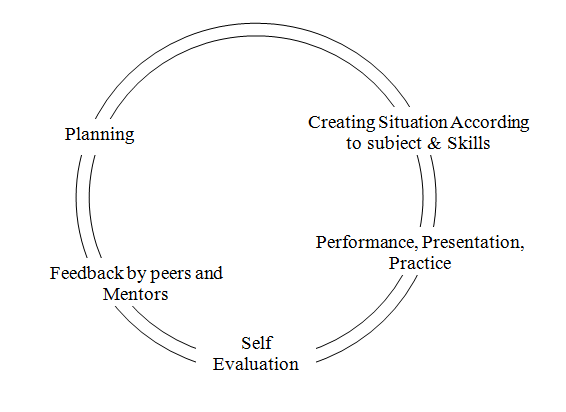
Level 1: Planning according to subject (not Lesson Plan)

Level 2: Creating situation according to subject and skill.

Level 3: Performance or presenting or practice

Level 4: Self Evaluation using technology like; Mobile, Video with projector Tablet, Laptop, Computer etc.,

Level 5 : Self – Evaluation, Evaluation by peers,  Mentor and Feed back

NANO – TEACHING CYCLE

nano teaching

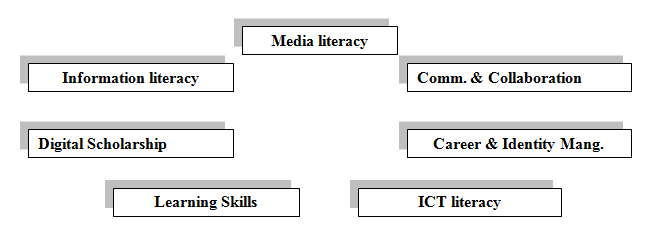
Seven Elements of Technology and literacy:

nano1

Levels of Technology:

Level 1: White Board, Interactive Board etc.,

Level 2: Charts, Models, Maps etc.,

Level 3: Mobile, Tab, Video, Lap-top, etc.,

Following table shows how technology using in Nano-Teaching evaluation.

Sl.No. Devices Evaluation Technique used
01. Mobiles SMS, MMS, Bluetooth, Camera, Video etc.
02. Video Video, Video projector etc.
03. Projects Film projector/micro projection, Multimedia projector, lead diode projector, Pico projection.
04. Computers Personal, Lap – top, Palm top, notebook, tablet and computers.
05. Advanced Technology Blogs, E-Resource Whatsup, Face book etc.

EVALUATION METHOD:

It is not possible to measure performance by giving simply by numbers or tallies like Yes/No type.  In micro teaching observation-cum-rating scale evaluation taking place tallies against components against rating scales.  To Evaluate performance in terms of tallies Yes/No, if yes, it is not possible to expect performance absolutely correct because sometimes some of the desirable behaviors may change so, it is not possible to give 0, 1, 2, 3, 4, and   there is no Zero performance so, 0 not valid, and even not possible to give 4 excellent, this is not possible expect excellent performance at the time of training, may some of the mistakes occur.  Because of all these limitations, here in Nano-Teaching evaluation take place in the following ways.

  1. I) SELF EVALUATION SHEET
Sl.No. Satisfied Not satisfied Remarks
  1. II) PEERS AND MENTORS EVALUATION SHEET


Sl.No. Satisfied Not satisfied Suggestions Remarks

DIFFERENCES BETWEEN MICRO AND NANO-TEACHING

Sl.No. Mirco-Teaching Sl.No. Nano-Teaching
1. Review by peers 1. Review by him/herself using Technology
2. Feedback by peers & Mentors. It develops.

a) Inferiority complex,

b) Guilty

c) Ego etc.,

2. Self evaluation. It  develops

a) Self confidence

b) Self awareness

c) Self realization

d) Self acceptance


3. More than seventeen skills 3. Self skill oriented.


4. Need formal class room, peers and observer/supervisor 4. Anywhere, without any peers and observes/supervisors like in front of mirrors and using other technologies.


5. We need external evaluator/observes

a) Whole evaluation for particular

Step.

b) Language will be précised

c)Weakening the interest in communication

5. Continues, comprehended self evaluation, going step by step.

a) Evaluating each mistake by him/self.

b) Language will be expanded in a wider range.

c) Strengthening the interest in communication.


CHANGE OF RFERENCES:


Sl.No. Oriental Method Technological method
01. Text Books Digital Books
02. Dictionary Wicktionary
03. Library On-Line Library
04. Discussions Forums and chats
05. Encyclopedia Wikipedia
06. Face to face discussion Video/Tele Conference
07. Papers pencil assessment E-Portfolio assessment

TEACHER’S ROLE

Research has consistently shown that one of the most important factors contributing to student-teacher’s success is the quality of teaching he/she receives. Fully leveraging the opportunities of technological learning and technology in the classrooms will require a shift in the role and skills of teachers. Among other roles, teachers will need to:

  • Facilitate Learning
  • Provide Technical Expertise
  • Leverage Technology to Individualize Instruction
  • Use Technology to Transform Assessment

CONCLUSION

Here information and communication technology as a diverse set of technology tools and resources used to create, communicate, manipulate, store and manage information and knowledge. Effective teachers can nurture the effective system of education. The advancement of science and technology has revolutionized the communication process, therefore information and communication technology should form an integral part of the education.

The purpose of the present investigation was assessing the level of knowledge of technology among the prospective teacher. In the present era, the development in various aspects of technology has reached beyond our imagination and expectation. As technology becomes part and parcel of our life, knowledge of technology is very much needed for everyone. Now we are living “systems of nano systems, “so that here Nano-teaching develops various techniques to develop teaching skills in a nano way. So here made an attempt to develop nano-teaching.

Now day’s kids are “digi-natives,” so, keeping in mind author invented and developed Nano-teaching: New Possibilities in the field of Teacher Education, and website reopened in the month of March 2016 by President, Reshmi Educational and Charitable Trust (R) Website is www.nanoteaching.info

REFERENCES

  1. Allen, D.W. (1966), Micro-Teaching: A Description, School of Education: Standford University.
  2. Lalitha, M.S. (1976) an enquiry into class room instruction: Un-Published Doctoral Dissertation M.S. University Baroda.
  3. Professor Jagadeesh. A (2004) Micro Teaching theory and practice: Siddanna Educational Society, Mahabubnagar.
  4. Paily, M.U. (2013) Emergency Trends in Pedagogy, Assessment and ICT, keynote Address, Christ University,  Bangalore.
  5. www.google.com – microteaching